
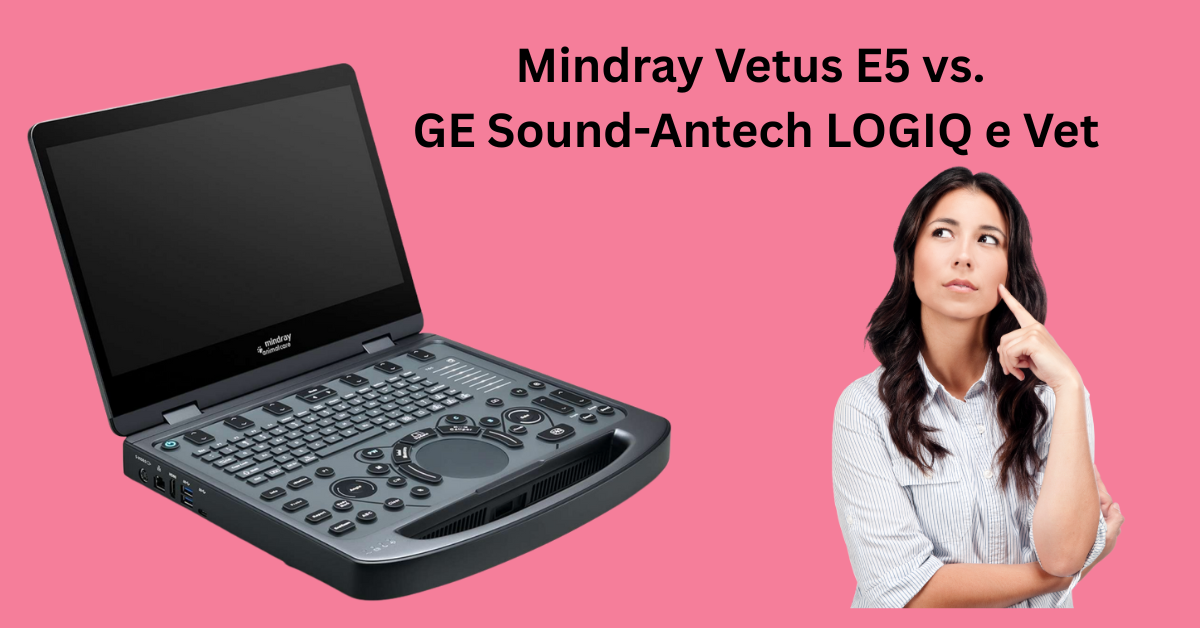
Comparing the Mindray Vetus E5 vs. the GE Sound-Antech LOGIQ e Vet
A real-world comparison for busy practices
Whether you’re upgrading your ultrasound capabilities or balancing performance with budget, the Mindray Vetus E5 and the GE Sound-Antech LOGIQ e Vet are two machines that frequently come up in conversation.
Both aim to help you scan confidently, efficiently, and with diagnostic clarity — but they take different paths to get there.
Let’s break down their differences and see which might be the best fit for you and your team.
1. Workflow & User Experience
Designed specifically for veterinary workflow, the E5 centers on intuitive, animal-centric scanning:
Touch-sensitive gain and controls make adjustments quick, even in dim exam rooms.
iTouch one-click optimization simplifies on-the-fly improvements in image quality.
Veterinary presets and iWorks protocols mean less time tweaking settings and more time scanning.
iReport templates support rapid, polished reporting without external software.
The overall feel is practical and vet-friendly — great for general practice, reproduction work, abdominal scans, and standard cardiac assessments.
GE LOGIQ e Vet
The LOGIQ e Vet carries forward GE’s tradition of hospital-grade imaging in a portable form:
Laptop-style portability with an HD screen and sealed controls for easier cleaning. The
Scan Assistant feature helps streamline exam routines.
Classic GE ergonomics, with optional trackpad/trackball navigation for seasoned sonographers.
If you’re used to traditional ultrasound interfaces or want a familiar platform across specialties, the LOGIQ e footprint will be comfortable and dependable.
2. Image Quality & Processing Tools
Mindray Vetus E5
Mindray’s ZST+ imaging platform powers the E5, giving you a suite of advanced image tools that matter in veterinary clinical work:
HR Flow & advanced Doppler modes support fine vascular assessment.
Natural Touch Elastography helps assess tissue stiffness (particularly in hepatic, splenic, and soft-tissue evaluations).
iClear speckle reduction and SmartCalc automated measurements shrink noise and speed quantification.
This suite of tools tends to improve everyday imaging quality, especially in small-animal abdominal work and soft-tissue characterization.
GE LOGIQ e Vet
LOGIQ e brings grayscale and Doppler imaging:
Broad imaging modes like B-mode, M-mode, Color Flow, Power Doppler, PW Doppler, and more are standard.
LOGIQ e’s core image engine is proven and reliable for abdominal, cardiac, and vascular imaging across species.
For practices with varied caseloads — from small animals to equine — the LOGIQ platform’s versatility is a key strength.
3. Portability & Durability
Lightweight and portable enough for in-clinic or off-site use, without a heavy cart.
Durable waterproof/dustproof control panel designed to tolerate hair, fluid, and accidental knocks — essential in high-volume vet settings.
Long battery life and easy probe switching keep daily workloads running smoothly.
GE LOGIQ e Vet
A laptop-style form factor makes it inherently portable, ideal for multi-room or field applications.
90-minute battery life between charges is standard on many configurations.
The E5’s design focuses on vet-specific ruggedness, while the LOGIQ e emphasizes proven portability and clinical durability.
4. Value & Warranty Considerations
Often, more aggressive pricing, including standard accessories like one transducer, cart, training, and a robust warranty.
With tools like SmartCalc and iReport included, practices find they get more built-in functionality per dollar.
GE LOGIQ e Vet
Carries a strong service and support ecosystem.
Pricing can be higher, especially when equipped with a full range of vetted veterinary probes and extended support plans.
5. Which One Fits Your Practice?
Here are a few quick scenarios:
General Practice:
The Vetus E5 often delivers excellent image quality, intuitive workflows, and substantial value. Its vet-centric software and reporting tools can save time in busy daily scanning.
Mixed Practice or Specialty Referral:
If you’re doing more cardiac or equine evals and want a platform with broad familiarity and flexibility, the LOGIQ e Vet might be a good choice.
Mobile / Field-Based Work:
Both units are portable, but Mindray’s rugged, purpose-built portability gives it a slight edge for rugged field use, while LOGIQ e’s laptop-style design and battery support make it ideal for point-to-point scanning.
The bottom line is that both systems have earned their place in modern veterinary practices. The E5 excels in intuitive vet workflows and built-in tools, while the LOGIQ e Vet brings a trusted, flexible platform with strong imaging fundamentals that spans diverse case loads.
The Mindray Vetus E5 stands out by delivering more practical performance for everyday veterinary work at a better overall value. Built specifically for veterinary workflows, it offers faster setup, one-click image optimization, cleaner abdominal and soft-tissue imaging, and built-in reporting that saves time on every scan.
Its rugged, vet-friendly design holds up in busy exam rooms, while advanced imaging tools come standard—without costly add-ons. For practices that want excellent image quality, efficiency, and ROI without paying a premium for a legacy platform, the Vetus E5 is the clear choice.