

Why CO₂ Lasers Are Especially Advantageous in Feline Surgery
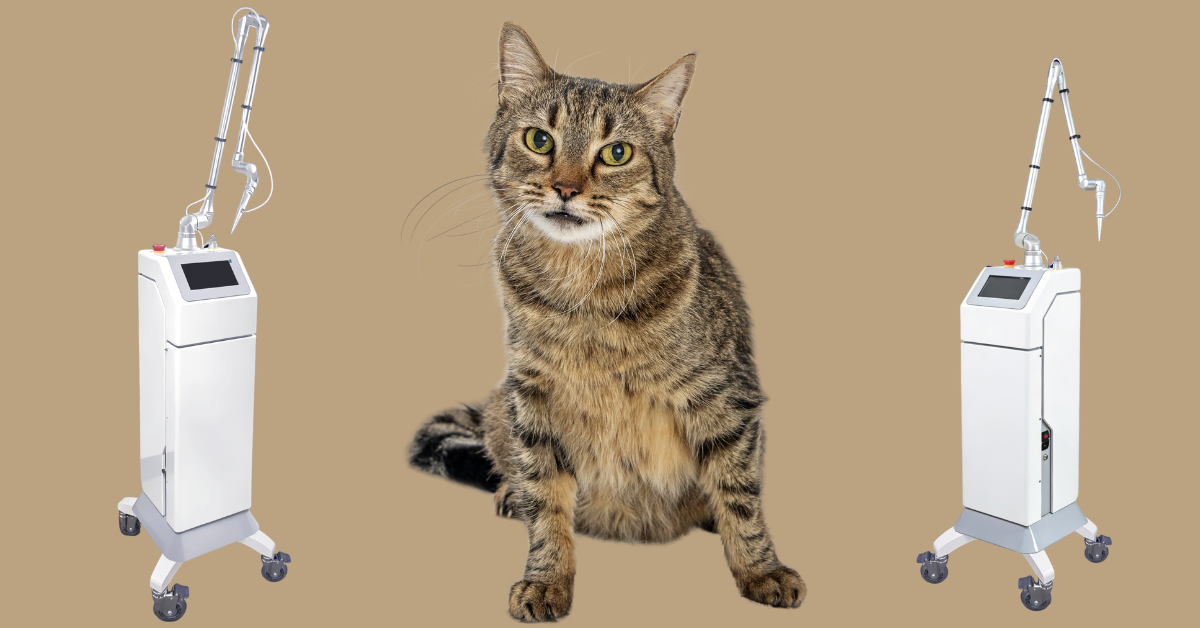
If there’s one patient population that keeps veterinarians on their toes in surgery, it’s cats. Smaller anatomy, delicate tissues, greater pain sensitivity, and reduced tolerance for postoperative discomfort all raise the stakes.
That’s exactly why CO₂ laser surgery has become such a valuable tool in feline procedures.
While scalpels will always have a place in the surgical suite, CO₂ lasers offer advantages that are particularly meaningful for cats—both clinically and operationally.
Precision That Matches Feline Anatomy
CO₂ lasers operate at a 10.6 µm wavelength, which is absorbed almost entirely by water in soft tissue. This results in extremely shallow penetration—about 100–200 microns—with a reversible thermal damage zone under 0.1 mm.
For feline patients, this matters. Cats have:
Thinner skin
Less subcutaneous fat
Smaller surgical margins
The laser’s minimal lateral heat spread allows for clean, controlled incisions without unnecessary trauma to surrounding tissue, which is especially valuable in areas like the mouth, eyelids, ears, and digits.
Reduced Bleeding in Naturally Smaller Patients
Even modest blood loss can be more clinically significant in cats.
Because CO₂ lasers cut and coagulate simultaneously, small blood and lymphatic vessels are sealed as the incision is made. This creates a clear, nearly bloodless surgical field, improving visibility and reducing total blood loss during procedures such as:
Mass removals
Oral surgeries
Declaws (where applicable)
Anal sac and perianal procedures
For the surgeon, better visibility means greater confidence and efficiency. For the patient, it means a safer surgical experience.
Less Postoperative Pain (and Less Stress)
Cats are notoriously subtle when it comes to expressing pain—and they’re also less forgiving of it.
CO₂ laser energy seals sensory nerve endings as it cuts, which can significantly reduce postoperative discomfort. Combined with minimal tissue trauma, feline patients often experience:
Less swelling
Reduced inflammation
Smoother recoveries
Faster return to normal behavior
From a practice owner’s perspective, this often leads to fewer post-op complications, fewer worried client calls, and higher overall client satisfaction.
Ideal for Oral and Dental Soft-Tissue Procedures
Feline oral disease is common, and oral surgery is one of the most compelling use cases for CO₂ lasers.
The laser’s precision allows for:
Gingivectomies and gingivoplasties
Stomatitis-related soft-tissue procedures
Tongue, lip, and cheek mass removal
With adjustable power up to 40 W and multiple operating modes (Continuous, Pulse, and Single), veterinarians can tailor energy delivery for everything from vaporization to fine ablation—without instrument changes.
Ultrapulse Mode for Fine, Controlled Cutting
Ultrapulse mode delivers short, high-peak-power bursts with minimal heat diffusion. In feline patients, this results in:
Cleaner incisions
Less collateral tissue damage
Faster healing
This is particularly beneficial when working in tight surgical fields or around critical structures.
Improved Workflow in High-Sensitivity Cases
CO₂ laser systems designed for veterinary use prioritize efficiency. Features like:
A full-color touchscreen with user-preset storage
A 7-joint articulated arm that holds position without drift
An aiming beam that precisely indicates spot size
All of which make procedures faster to set up and easier to perform, especially helpful when anesthetic time matters, as it often does with cats.
Integrated Smoke Evacuation = Better Focus
Laser plume can obscure visibility and interrupt surgical flow. Built-in smoke evacuation keeps the field clear automatically, allowing the surgeon to remain focused on tissue handling rather than managing suction, an underrated benefit during delicate feline procedures.
A Smart Investment for Practices That See Cats Regularly
From a business standpoint, CO₂ lasers enable practices to expand in-house feline services, including:
Oral and dental soft-tissue surgery
Mass and tumor removal
Dermatologic lesion ablation
Anal sac procedures
With one system and a set of handpieces, practices can offer multiple high-value feline procedures while improving outcomes and client perception of advanced care.
Acknowledging the Trade-Offs
Like all CO₂ laser systems, there are considerations:
Laser tubes may gradually lose power over time, though increasing wattage compensates effectively.
Articulated arms should be handled with care due to internal glass components.
These are manageable factors and common across CO₂ laser technology, and for most feline-focused practices, they’re far outweighed by the clinical advantages.
Why CO₂ Lasers Make Sense for Cats
Cats demand precision, efficiency, and gentleness—and that’s exactly where CO₂ lasers excel.
By minimizing bleeding, reducing pain, and allowing unparalleled control in small surgical fields, CO₂ lasers elevate feline surgery from “successful” to truly optimized. For veterinarians and practice owners alike, it’s a technology that supports better medicine, better experiences, and better outcomes for one of our most sensitive patient populations.