

CO₂ Surgical Laser vs. Vessel Sealer: Which Tool Makes Sense for Your Practice?
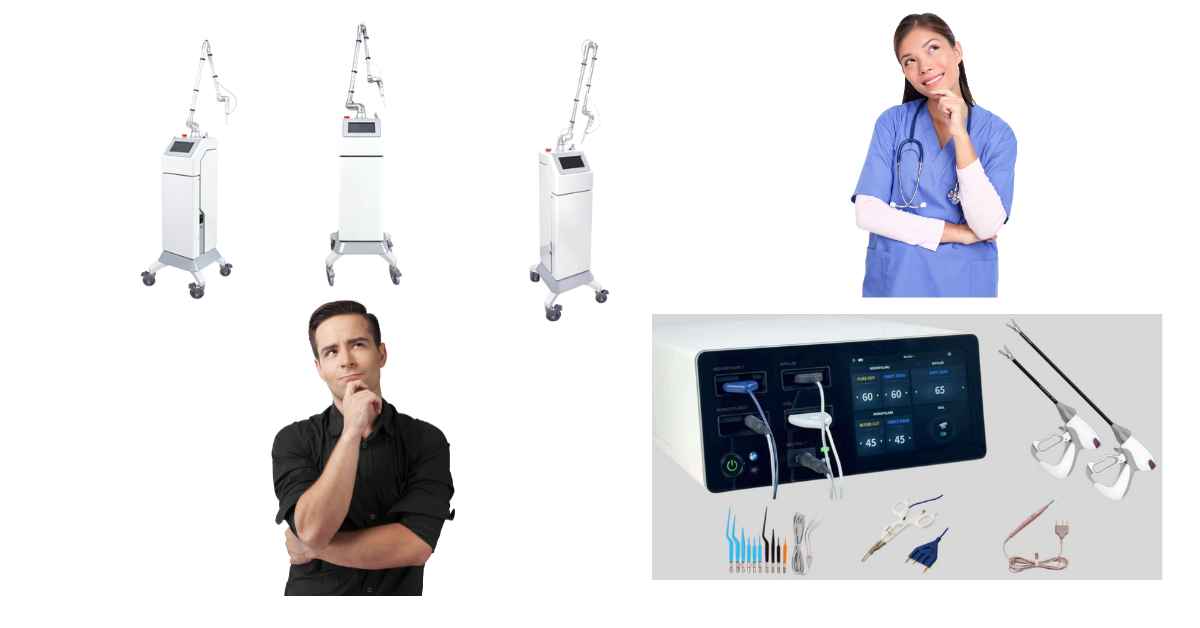
If you’ve ever priced out new surgical equipment, you’ve probably found yourself comparing apples to… not quite oranges, but definitely different fruits.
Two technologies that often come up in the same conversation are CO₂ surgical lasers and advanced vessel sealing devices. Both are marketed as modern upgrades to traditional surgical tools. Both can reduce bleeding. And both promise better outcomes.
But they’re designed for very different jobs.
Understanding where each excels and where each falls short can help you decide which investment actually fits your practice and caseload.
What Each Technology Is Designed to Do
Let’s start with intent.
CO₂ Surgical Laser
A CO₂ laser is a soft-tissue cutting tool. It uses a 10.6 µm wavelength that’s strongly absorbed by water, allowing it to cut, vaporize, ablate, and coagulate tissue with extreme precision and minimal thermal spread.
Vessel Sealer
A vessel sealer is primarily a hemostasis tool. It uses bipolar energy and pressure to seal blood vessels and tissue bundles—typically larger structures—before transection.
Both are valuable, but they’re not interchangeable.
Precision vs. Power
CO₂ lasers shine in precision work.
Because laser energy penetrates only about 100–200 microns into tissue, lateral thermal damage is extremely limited. This makes CO₂ lasers ideal for:
Oral and dental soft-tissue surgery
Dermatologic mass removal
Periocular and ENT procedures
Anal sac surgery
Feline and small-patient procedures
A vessel sealer, on the other hand, is designed for larger tissue bundles and vessels. It excels when sealing and dividing pedicles, such as during:
Ovariohysterectomies
Splenectomies
Large mass removals involving vascular structures
If you’re looking for fine margins and delicate tissue handling, the CO₂ laser has a clear advantage. If your primary need is sealing larger vessels quickly and securely, a vessel sealer may be more appropriate.
Cutting and Coagulation: One Step vs. Two
One of the biggest workflow differences comes down to how these tools handle cutting.
A CO₂ laser cuts and coagulates simultaneously. Small blood and lymphatic vessels are sealed as the incision is made, often resulting in a nearly bloodless surgical field without stopping to cauterize.
A vessel sealer seals first, then divides tissue, often with scissors or an integrated cutting mechanism. It’s effective, but it’s not designed for continuous incision work.
For surgeries involving long incisions, mucosal tissue, or irregular lesion borders, lasers tend to feel faster and more fluid.
Postoperative Pain and Healing
From a patient-care perspective, this is where CO₂ lasers often stand out.
Laser energy seals sensory nerve endings and causes less collateral tissue trauma than mechanical cutting. Clinically, this often translates to:
Reduced postoperative pain
Less swelling and inflammation
Faster healing
This is especially noticeable in cats and small dogs, where even minor tissue trauma can lead to significant discomfort.
Vessel sealers are excellent at hemostasis, but they are not designed to minimize surface tissue trauma or nerve irritation in the same way, particularly in superficial or mucosal tissues.
Versatility Across Procedures
A single CO₂ laser system can support a wide range of soft-tissue procedures with different handpieces and settings:
Oral and dental soft tissue
Dermatology
Ophthalmic and ENT procedures
Urogenital surgery
Anal sac surgery
Tumor excisions
A vessel sealer tends to be more procedure-specific. It’s invaluable in abdominal and highly vascular surgeries but is rarely used for oral, dermatologic, or superficial soft-tissue work.
For many general practices, that versatility plays a big role in ROI.
Learning Curve and Daily Use
CO₂ lasers are often easier to integrate into daily workflows than expected. Modern systems feature:
Touchscreen interfaces with user presets
Articulated arms for stable positioning
Aiming beams that show exactly where energy will be delivered
Many veterinarians find they can incorporate laser surgery quickly, especially for procedures they already perform frequently.
Vessel sealers, while straightforward, tend to be used in a narrower set of surgeries, which can limit how often they’re pulled out of storage.
The Business Side: Which Pays Off Faster?
From a practice-owner standpoint, the question often becomes: Which tool will we actually use most?
CO₂ lasers often generate ROI through:
Expanded in-house soft-tissue procedures
Reduced surgical time
Improved patient outcomes and client satisfaction
Higher perceived level of care
Vessel sealers provide strong value in practices performing high volumes of abdominal or complex soft-tissue surgeries, but may see less frequent use in smaller or feline-heavy practices.
So… Which One Is “Better”?
Neither tool replaces the other.
A vessel sealer is a powerful hemostasis device for larger vessels and tissue bundles. A CO₂ laser is a precision instrument for soft-tissue surgery, patient comfort, and versatility.
If your practice performs a wide variety of soft-tissue procedures, especially oral, dermatologic, or feline cases, a CO₂ laser often delivers broader day-to-day value. If you routinely tackle large, vascular abdominal surgeries, a vessel sealer may be a better complement.
For some practices, the ideal setup is eventually having both, but if you’re choosing where to start, understanding your caseload is everything.