

Veterinary CT Buyers Guide: How Does the VetiST 3 Stack Up Against Alternatives?
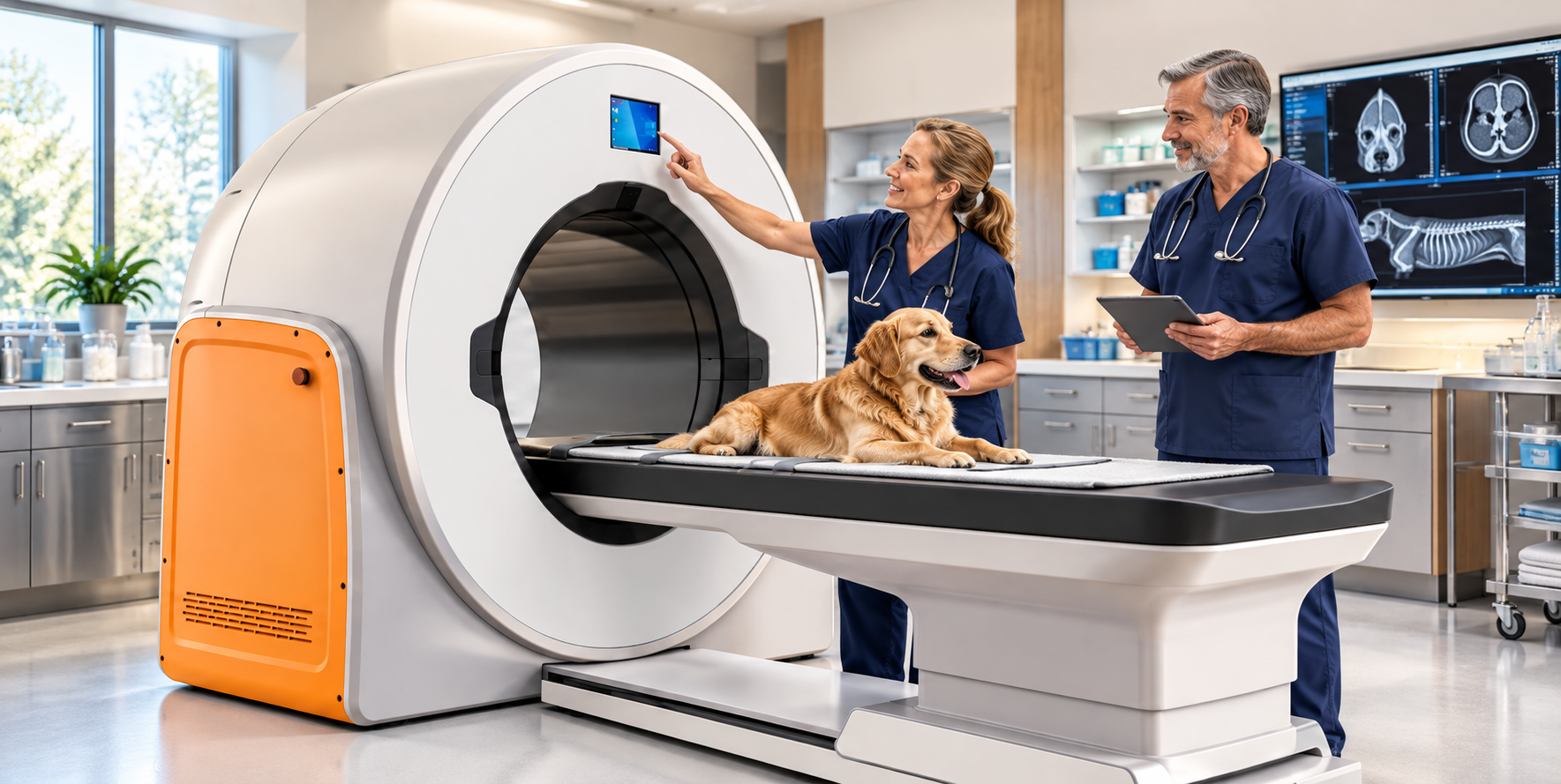
Comparing Veterinary CT Scanners: Features, Costs, and Patient Capacity
Choosing a CT scanner is a big investment for any veterinary practice. There's a lot to consider before bringing advanced imaging in-house.
- Purchase price
- Installation requirements
- Maintenance and support
- Patient size and capacity
- Imaging capabilities
The good news? Today's veterinary CT market offers options for different budgets, caseloads, and clinical needs.
The challenge is understanding what you're actually getting for your money.
Here's the key: Don't compare scanners by price alone. Compare the entire package, including installation, warranties, service, and the types of patients you can scan.
What to Consider Before Buying a Veterinary CT Scanner
Choosing the right CT scanner goes beyond the initial purchase price. Before committing to a system, consider how its capabilities, ongoing costs, and support align with your practice's needs.
- Imaging capabilities: Consider slice count, image resolution, scan speed, and whether cone-beam or conventional CT best suits your clinical caseload.
- Patient capacity: Evaluate gantry aperture, table weight limits, and scan coverage to make sure the system accommodates the dogs and cats you typically treat.
- Total cost of ownership: Include purchase price, installation, room modifications, radiation shielding, maintenance, software, and service agreements.
- Warranty and technical support: Review warranty duration, exclusions, response times, replacement-parts availability, and post-warranty service costs.
- Space and installation requirements: Confirm room dimensions, electrical requirements, facility modifications, and necessary regulatory approvals.
- Return on investment: Estimate scan volume, pricing, referral opportunities, and operating expenses. Determine whether bringing CT in-house makes financial sense.
Meet the Contenders: Six Veterinary CT Options
Let's compare the VetiST 3 Veterinary CT System with five refurbished conventional CT alternatives.
These systems have different technologies, capabilities, and price points. Understanding those differences will help you identify which features matter most for your practice.
VetiST 3 Veterinary CT System
The VetiST 3 is a cone-beam CT (CBCT) system that combines four imaging modalities in one system.
- CT imaging
- Digital radiography
- Fluoroscopy
- Panoramic imaging
Financing is available.
The package includes:
- 3-year warranty
- Technical support
- Software updates
- Shielding plan
- Shipping and installation
Patient specifications: 80 cm gantry aperture, 72 × 42 cm maximum field of view, and 135 kg (298 lb) table capacity.
View the VetiST 3 CT scanner for additional product details.
Five Refurbished CT Alternatives Worth Investigating
Refurbished conventional CT systems can provide another route to advanced imaging. However, pricing and included services may vary considerably between sellers.
GE BrightSpeed 16 Vet
A refurbished 16-slice conventional CT option for veterinary practices.
Approx. $110,000–$185,000
Pricing depends on condition, configuration, and included installation or service.
GE LightSpeed 16 Vet
An established conventional CT platform available refurbished.
Approx. $95,000–$160,000
Final pricing depends on the specific scanner and package.
GE LightSpeed VCT 64 Vet
A 64-slice conventional CT system for practices evaluating higher-throughput imaging capabilities.
Approx. $175,000–$325,000
Pricing varies by model year, configuration, and refurbishment level.
Siemens SOMATOM Emotion 16 Vet
A refurbished conventional CT option worth evaluating for veterinary use.
Approx. $95,000–$150,000
Availability and configuration can affect pricing.
GE Optima 660 Vet
A refurbished conventional CT system to consider when evaluating advanced imaging capabilities.
Approx. $225,000–$375,000
Compare the complete refurbishment, warranty, installation, and service package.
Note: Refurbished prices are approximate planning estimates, not verified current seller quotes. Actual pricing, condition, availability, and package inclusions must be confirmed.
Why Does CT Slice Count Matter?
Slice count can influence how a conventional CT scanner captures images, especially how quickly it can cover a region of the body.
Higher-slice systems can acquire more image sections per rotation, which may benefit larger anatomical studies and faster scanning.
However, slice count alone does not determine image quality or clinical usefulness. Detector technology, image resolution, scan protocols, and reconstruction software also play important roles.
Important distinction: Cone-beam CT and conventional multi-slice CT use different imaging technologies. Their slice-count specifications are not directly interchangeable.
The better question is whether the system can produce the diagnostic images your veterinarians need for the exams they perform most often.
What About the Size of Dogs and Cats?
Patient capacity can be a deciding factor, especially for practices treating everything from small cats to giant-breed dogs.
Two important specifications are:
- Gantry aperture: The opening available to position a patient for imaging.
- Patient table capacity: The maximum patient weight the table can safely support.
Scan field of view and coverage also matter. A table may support a large dog, but the scanner must still be able to capture the required anatomy.
Veterinary CT Patient Capacity Comparison
Here's a side-by-side look at reported gantry openings and table capacities.
| CT System | Gantry Aperture | Patient Table Capacity |
|---|---|---|
| VetiST 3 | 80 cm | 135 kg (298 lb) |
| GE BrightSpeed 16 | 70 cm | Approx. 205 kg (452 lb) |
| GE LightSpeed VCT 64 | 70 cm | Approx. 227 kg (500 lb) |
| Siemens SOMATOM Emotion 16 | 70 cm | Approx. 200 kg (440 lb) |
| GE Optima 660 | Confirm with seller | Confirm with seller |
| GE LightSpeed 16 | Confirm with seller | Confirm with seller |
Table capacities and apertures are comparison specifications supplied for this article. Confirm the exact specifications for each individual system and configuration before making a purchase. The VetiST 3 also has a reported maximum field of view of 72 × 42 cm.
When comparing patient capacity, evaluate the complete picture:
- Gantry opening
- Patient table capacity
- Maximum field of view
- Scan coverage
- Types of examinations performed
These details help determine whether a system can handle your everyday veterinary caseload.
Don't Overlook the Total Cost of Ownership
The initial purchase price is only part of the equation. A less expensive scanner upfront may not be the least expensive system to own over time.
For example, the VetiST 3 has a $175,000 package price that includes shipping, installation, and a three-year warranty.
When comparing different systems, pay close attention to:
- Warranty exclusions
- Preventive maintenance requirements
- Replacement parts
- Software and update costs
- Technical support and service pricing
Additional Questions for Refurbished CT Systems
If you're considering refurbished conventional CT equipment, request a detailed written breakdown covering:
- Installation: Is delivery, rigging, and installation included?
- Tube condition: What is the tube's operating history, and what would replacement cost?
- Parts availability: Are replacement components readily available?
- Service coverage: Who provides repairs, and what are the response times and costs?
- Facility requirements: What electrical, cooling, structural, and radiation shielding modifications will your building need?
A smart buying decision: Request an itemized quote showing the complete installed price, warranty coverage, recurring expenses, and anticipated service costs.
This gives you a much more meaningful comparison than purchase price alone.
Which Veterinary CT Scanner Is Right for Your Practice?
There isn't one perfect CT system for every veterinary hospital.
The right choice depends on your caseload, diagnostic goals, available space, and budget.
Before making a final decision, ask for written documentation covering:
- Complete purchase and installation pricing
- Warranty terms and exclusions
- Technical support and service expenses
- Patient weight and size capacity
- Clinical imaging capabilities
- Facility and installation requirements
These details can help you make a more informed investment in your practice and your patients.
Have Questions About the VetiST 3 Veterinary CT?
Advanced imaging is an important investment. You deserve clear answers before making that decision.
If you're considering the VetiST 3 CT scanner, I'd be happy to help you review its features, patient capacity, pricing, financing, and installation requirements.
My goal is simple: Help you make a confident, informed equipment purchasing decision.
Brad Haven, Jr.
NewVetEquipment.com
877-545-1202
Veterinary CT Systems: Side-by-Side Comparison
Compare six veterinary CT systems by imaging technology, patient capacity, warranty, installation, and facility requirements. Be sure to confirm specifications and included services before purchasing.
← Swipe or scroll horizontally to compare all six systems →
| Feature | VetiST 3 | GE BrightSpeed 16 | GE LightSpeed 16 | GE LightSpeed VCT 64 | Siemens SOMATOM Emotion 16 | GE Optima 660 |
|---|---|---|---|---|---|---|
| CT Technology | Cone-beam CT | Conventional CT | Conventional CT | Conventional CT | Conventional CT | Conventional CT |
| Slice Configuration | Up to 600 slices advertised | 16-slice | 16-slice | 64-slice | 16-slice | 128-slice configuration |
| Additional Imaging | Digital radiography (DR), fluoroscopy, panoramic imaging | Depends on configuration | Depends on configuration | Depends on configuration | Depends on configuration | Depends on configuration |
| Gantry Aperture | 80 cm | 70 cm | Verify unit | 70 cm | 70 cm | Approx. 70 cm |
| Maximum Table Load | 135 kg / 298 lb | 205 kg / 452 lb | Verify unit | 227 kg / 500 lb | Approx. 200–220 kg / 441–485 lb | Approx. 227 kg / 500 lb |
| Advertised Purchase Price | $175,000 | Quote required | Quote required | Quote required | Quote required | Quote required |
| Warranty | 3 years advertised | 1 year parts and labor advertised | Confirm with seller | 1 year parts and labor advertised | Confirm with seller | Confirm with seller |
| Installation | Included in advertised package | Typical installation included | Confirm with seller | Typical installation included | Confirm with seller | Confirm with seller |
| Room Size | Confirm with vendor | Approx. 18.2 m² | Confirm with vendor | Approx. 34.2 m² | Approx. 18 m² | Confirm with vendor |
Important: Advertised features and specifications may vary by configuration, model year, equipment condition, and seller. Room sizes are approximate and may not include all required support space. Confirm current pricing, clinical capabilities, warranty terms, facility requirements, and installation costs directly with each equipment supplier.
Understanding slice counts: Cone-beam CT and conventional multi-slice CT use different acquisition methods. The VetiST 3's advertised 600-slice figure should not be interpreted as equivalent to the slice configuration of a conventional 16-, 64-, or 128-slice CT scanner.