
Is Veterinary CT Worth the Investment? Calculating Costs, Revenue, and ROI
Adding a veterinary CT scanner to your practice can open the door to new diagnostic capabilities, expanded services, and additional revenue.
But with a significant upfront investment and ongoing operating expenses, how do you know if bringing CT in-house makes financial sense for your veterinary hospital?
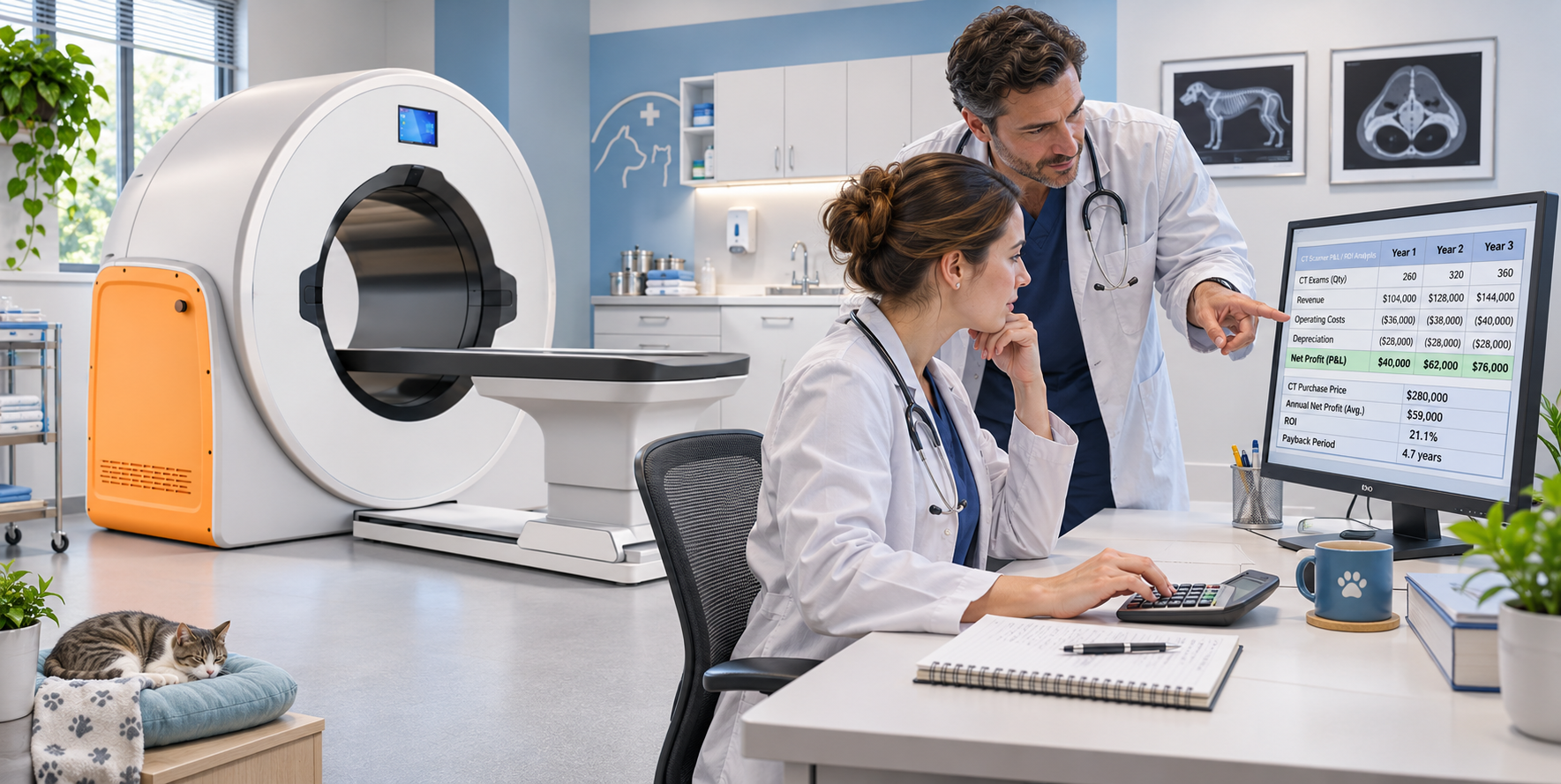
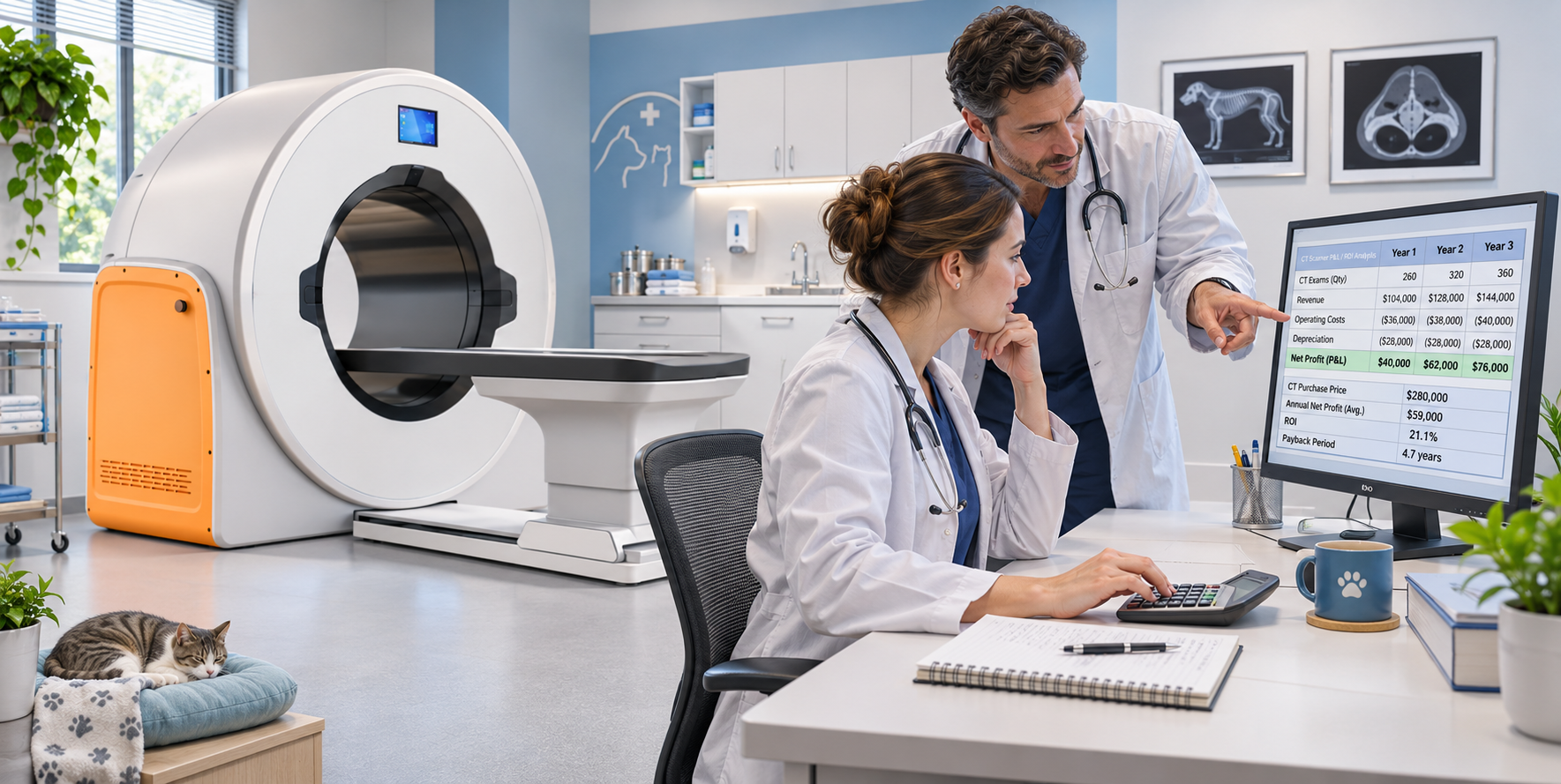
The answer goes beyond the scanner's purchase price. A realistic return-on-investment (ROI) calculation should consider the full cost of ownership, how many scans your practice can reasonably perform, and the revenue or savings those scans may generate.
Before making a decision, let's look at the numbers that matter and how you can use them to evaluate an investment in veterinary CT.
Start With the Total Cost of Owning a Veterinary CT Scanner
The purchase price is an obvious starting point, but it is only one part of the financial picture.
Before purchasing a CT system, identify both the upfront expenses and the recurring costs your practice will need to cover.
Installation and Room Preparation
Electrical upgrades, construction, flooring, equipment delivery, and installation may add to the initial investment.
Ask what is included with the scanner and what your practice will be responsible for providing. Some systems include installation and delivery, while others may require additional expenses.
Radiation Shielding and Safety Requirements
Depending on the CT system and room design, radiation shielding and required safety evaluations may be necessary.
Work with qualified radiation safety professionals to determine the requirements for your facility and applicable regulations.
Staffing and Training
Consider whether your hospital will need additional technicians, dedicated imaging personnel, or more staff hours to accommodate CT examinations.
Include initial equipment training and any ongoing education your team may need to operate the scanner confidently and efficiently.
Maintenance, Service, and Software
Routine maintenance, service agreements, software support, repairs, and replacement parts can affect annual operating costs.
Review the warranty carefully. Understand which services are included, which are excluded, and what may happen when the warranty expires.
Variable Costs for Every CT Scan
Every examination may have additional costs. Depending on the procedure, these can include:
- Contrast materials and medications.
- Anesthesia or sedation supplies, when needed.
- Disposable supplies.
- Radiologist interpretation fees, when applicable.
- Additional labor directly associated with the procedure.
These expenses matter because the full amount collected for a CT scan is not necessarily profit.
Equipment Financing or Cash Purchase
Whether you purchase the scanner outright or finance it, account for the appropriate equipment cost in your financial projections.
If you finance the system, your cash-flow projection should include the required loan payments. If you purchase it outright, consider the initial capital investment and how you expect to recover it over time.
Important: Avoid counting the full purchase price and the loan payments as separate expenses in the same calculation. Also, distinguish accounting depreciation from actual cash payments when analyzing profitability versus cash flow.
Where Does the Revenue From Veterinary CT Come From?
One of the biggest advantages of in-house CT is the opportunity to keep more of the diagnostic process within your practice.
When patients are referred elsewhere for advanced imaging, your practice may lose not only the imaging revenue, but also opportunities to provide associated services.
Bringing CT in-house can help your team manage more of the diagnostic process and coordinate follow-up care.
Potential Sources of CT Revenue
- Your own patients: CT examinations performed for patients already receiving care at your veterinary hospital.
- Outside referrals: Imaging services provided to patients referred by other veterinarians.
- Additional diagnostic services: Appropriate diagnostic procedures and treatment planning supported by CT findings.
- Follow-up care: Medically appropriate procedures and ongoing treatment that can remain within your practice.
CT can support a variety of clinical applications. For a closer look at how veterinarians use this technology, read our article about seven veterinary CT applications and their role in diagnostic workups.
Why Referral Relationships Matter
Referral revenue can be especially important when evaluating a veterinary CT investment.
If nearby veterinary practices regularly refer patients for advanced imaging, those relationships may help generate additional CT scan volume beyond your existing caseload.
However, don't build your financial projections around referrals that have not been established.
Start with realistic estimates based on your current patient population, local demand, and conversations with potential referral partners.
How to Calculate Your Veterinary CT Break-Even Point
So, how many CT scans would your practice need to perform for this investment to make financial sense?
A helpful starting point is to calculate your annual fixed costs and the amount your practice earns from each scan after variable expenses.
This amount is called the contribution margin per scan. It is the money available to cover fixed costs and, once those costs are covered, contribute toward profit.
Example: Breaking Even on a Veterinary CT Scanner
Let's say your estimated annual fixed costs for owning and operating a veterinary CT service are $72,000.
Depending on how your practice models the investment, those costs might include equipment financing or depreciation, service agreements, allocated staffing, and other recurring expenses. Use a consistent cash-flow or accounting basis.
Now assume your practice collects an average of $1,200 per CT scan and spends $200 in variable costs for each examination.
Sample Veterinary CT Break-Even Calculation
| Financial Item | Example Amount |
|---|---|
| Annual fixed costs | $72,000 |
| Average revenue collected per scan | $1,200 |
| Variable cost per scan | $200 |
| Contribution margin per scan | $1,000 |
| Annual scans needed to break even | 72 |
| Average monthly scans needed | 6 |
Step 1: Calculate contribution per scan.
Step 2: Divide annual fixed costs by contribution per scan.
Your estimated break-even volume is 72 scans annually, or an average of six scans per month.
In this simplified example, completing six CT scans per month would generate enough contribution to cover the assumed annual fixed costs.
But this is not a universal benchmark. Your actual break-even point depends on:
- Equipment purchase price.
- Financing terms and payment amounts.
- Staffing and labor expenses.
- CT scan fees and actual collections.
- Maintenance and service costs.
- Patient volume and referral demand.
- Variable expenses associated with each scan.
Remember: This calculation represents operating break-even under the stated assumptions. It does not necessarily mean you have recovered your full initial investment or achieved your desired profit.
Operating Break-Even vs. Full Return on Investment
Break-even is an important milestone, but it is only part of an investment analysis.
Your practice may cover the recurring expenses of its CT service while still working toward recovering its original capital investment.
When evaluating full ROI, consider the initial investment, any remaining equipment financing, the expected useful life of the scanner, and the net cash flow the service may produce over time.
If your goal is to estimate the time needed to recover your original investment, use a cash-flow payback calculation that accounts for the initial cash outlay and the ongoing net cash generated by the CT service, without double-counting loan principal or equipment depreciation.
This distinction helps prevent an attractive break-even estimate from creating unrealistic expectations about overall profitability.
Build a Realistic CT Revenue Projection Before You Buy
Once you understand your break-even point, compare it with your practice's actual and projected patient volume.
Begin by reviewing the cases your team sees today.
- How many patients could appropriately benefit from CT each month?
- How many cases are currently referred elsewhere for advanced imaging?
- How often would in-house CT change your diagnostic or treatment planning?
- Are nearby veterinarians interested in referring patients for CT?
- Does your team have the staffing and scheduling capacity to perform these examinations?
Compare Three Financial Scenarios
Instead of relying on one optimistic estimate, create several projections that reflect different levels of demand.
| Scenario | Scan Volume Assumptions | Purpose |
|---|---|---|
| Conservative | Lower scan volume with limited outside referrals. | Understand the financial risk of slower adoption. |
| Expected | Realistic demand based on current cases and likely referral relationships. | Evaluate the most reasonable operating plan. |
| Growth | Higher scan volume as awareness and referral activity increase. | Explore potential long-term opportunities. |
Running these scenarios helps you understand how sensitive your financial outlook is to changes in scan volume.
It also makes it easier to identify whether the investment would remain manageable if referrals develop more slowly than expected.
Choose a CT System That Fits Your Practice
Financial performance is important, but the right CT scanner must also meet your clinical needs.
Before committing to a system, consider the types of examinations your practice expects to perform, the size of the patients you treat, available space, image quality requirements, and support options.
There are also important differences between cone-beam CT and conventional CT technology. These differences can affect which system best suits your diagnostic workload.
Our cone-beam CT versus conventional CT comparison explains the differences and provides additional information to consider before purchasing.
A lower purchase price may look attractive, but long-term value also depends on the capabilities you need, the service you receive, and how well the equipment fits your practice's plans.
Frequently Asked Questions About Veterinary CT ROI
1. How many CT scans per month does a veterinary practice need to break even?
The answer depends on your fixed expenses, collected scan fees, and variable costs. In our example, $72,000 in annual fixed costs and a $1,000 contribution per scan require 72 scans per year, or six per month, to reach operating break-even.
2. What expenses should be included in veterinary CT ownership costs?
Consider acquisition and financing, room preparation, radiation shielding, staffing, training, maintenance, service agreements, software, and the costs directly associated with each scan. Be sure to separate upfront investments from recurring expenses.
3. Can outside referrals improve veterinary CT profitability?
Yes. Outside referrals can increase scan volume and help spread fixed costs across more examinations. However, referral revenue should be estimated conservatively until there is evidence of reliable demand and established referral relationships.
4. Is operating break-even the same as recovering the purchase price?
No. Operating break-even means the CT service generates enough contribution to cover the expenses included in that calculation. Recovering the initial investment may take additional time and should be evaluated separately through a cash-flow or investment return analysis.
5. Should I finance a veterinary CT scanner or purchase it outright?
That decision depends on your practice's available capital, borrowing costs, expected scan revenue, and financial priorities. Financing spreads equipment payments over time but creates an ongoing payment obligation. An outright purchase requires more capital upfront. Compare both options using realistic cash-flow projections.
6. What should I evaluate beyond the CT scanner's purchase price?
Consider clinical capabilities, patient size limitations, room requirements, warranty coverage, technical support, installation costs, service availability, and your expected caseload. The lowest-priced system is not necessarily the best long-term investment.
The Bigger Picture: Is Veterinary CT Worth the Investment?
A veterinary CT scanner can be a meaningful investment for your practice, but the right decision requires understanding the complete financial picture.
That means evaluating total operating costs, realistic revenue opportunities, and the number of scans your practice can consistently support.
When the numbers make sense, bringing CT in-house can help expand your diagnostic services, strengthen referral relationships, and keep more patient care under one roof.
The best investment is not necessarily the CT scanner with the lowest purchase price. It is the system that aligns with your clinical needs, financial goals, and long-term plans.
Have Questions About Veterinary CT?
Choosing a CT scanner is an important decision, and you shouldn't have to sort through equipment options, pricing, and installation requirements on your own.
Brad Haven, Jr. at New Vet Equipment can help you explore your options, ask the right questions, and identify equipment that fits your practice.
Prefer to talk? Call 877-545-1202 .
Stop Paying Too Much for Veterinary Equipment.
Vetist 3 Veterinary CT ROI Calculator
Could bringing CT imaging into your veterinary practice make financial sense?
Enter your estimated scan fees, patient volume, and expenses to see your potential revenue, contribution per scan, cash flow, and break-even point.
3-year warranty • Shipping and installation included
Financing available • Technical support and software updates
Ready to Discuss the Vetist 3?
The Vetist 3 combines cone beam CT, digital radiography, fluoroscopy, and panoramic imaging in one system.
Contact Brad Haven, Jr. to discuss equipment pricing, facility requirements, financing, and whether the Vetist 3 is a good fit for your veterinary practice.
Financial planning disclaimer: This calculator provides estimates based on the information you enter. Initial values other than the advertised equipment price are illustrative, not guaranteed market averages. Results are before income taxes and exclude unentered costs. "Contribution per scan" is revenue less direct per-scan expenses, not final net profit. Monthly surplus reflects operating cash-flow assumptions and any entered equipment payment; it is not accounting net income. Cash-purchase payback assumes constant monthly surplus and does not account for the time value of money, equipment resale value, taxes, or changing costs. For financed purchases, down payments, payoff balances, and financing costs beyond the entered monthly payment are not modeled. Consult your accountant or financial advisor before making a major equipment investment.
Stop Paying Too Much for Veterinary Equipment.
